
"Graphic design is everything you can see and experience. I think life is graphic design really."
- Anthony Burrill
Wednesday, February 9, 2011


is the new york times reading my blog?
What with their stories on banh mi, which I wrote about for the banh mi throwdown, and their coverage of Husk Restaurant which I just posted about my visit, I'm begining to think the New York Times dining writers are just stealing ideas from this blog.
Wishful thinking.
Wishful thinking.
Tuesday, February 8, 2011
Saturday, February 5, 2011
recipe: pork tenderloin with preserved lemons over couscous
I tend to not cook much meat, especially nicer cuts of meat due to my fear of overcooking them. But when my parents visited and brought me a freezer full of frozen goods ranging from her homemade casseroles to a pork tenderloin, I knew I had the perfect accompaniment for the dish.
For Christmas presents for several family members, I had made preserved lemons. Preserved lemons are quite easy to make and I was able to bulk purchase Meyer lemons at Trader Joes. I made a jar for myself and they were just about ready to use when the bounty of meats arrived. Googling turned up a few recipes for pork with preserved lemons, but the most delicious sounding was one from Bon Appétit that didn't actually use preserved lemons. So naturally I had to adapt it just a bit. I ended up creating a new(ish) dish: Pork Tenderloin over Isreali Couscous with a Preserved-Lemon Butter Sauce.
Despite my fears and the possibility that I sliced the pork much thicker than an inch (it took far longer to cook than expected) the meal turned out great, one of my favorites for a long time. The preserved lemon tastes incredibly fresh and adds a sweet note to the meal and the vegetables crunch is complemented by the chewier couscous.
Ingredients
Add stock and preserved lemon to skillet. Boil until reduced to 1 cup, about 7 minutes. Whisk in remaining 4 tablespoons butter. Add tomatoes and peppers. Cook for 2-3 minutes more. Season to taste with salt and pepper. Place pork on top of couscous and pour sauce over both.
 [Phone picture halfway through the meal. With roomie's green beans.]
For Christmas presents for several family members, I had made preserved lemons. Preserved lemons are quite easy to make and I was able to bulk purchase Meyer lemons at Trader Joes. I made a jar for myself and they were just about ready to use when the bounty of meats arrived. Googling turned up a few recipes for pork with preserved lemons, but the most delicious sounding was one from Bon Appétit that didn't actually use preserved lemons. So naturally I had to adapt it just a bit. I ended up creating a new(ish) dish: Pork Tenderloin over Isreali Couscous with a Preserved-Lemon Butter Sauce.
Despite my fears and the possibility that I sliced the pork much thicker than an inch (it took far longer to cook than expected) the meal turned out great, one of my favorites for a long time. The preserved lemon tastes incredibly fresh and adds a sweet note to the meal and the vegetables crunch is complemented by the chewier couscous.
Ingredients
- 1 tablespoon coarsely ground black pepper
- 1 1/2 pounds pork tenderloin, cut into 1-inch-thick medallions
- 4 or 5 tablespoons butter
- 2 cup chicken stock or canned broth
- 1/4 cup fresh lemon juice
- 2 tablespoons capers, drained
- peel of 1 preserved lemon, diced
- 16 oz Israeli couscous
- 1 cup red peppers, roughly diced
- 1 cup cherry tomatoes, sliced in half
Press pepper onto both sides of pork pieces. Heat 1 tablespoon butter in heavy large skillet over medium heat. (Or do as I did and cook in your bacon-fat seasoned skillet.) Season pork with salt. Cook until just cooked through, about 4 minutes per side. Transfer to plates and keep warm.

[Pork in the skillet.]
Add stock and preserved lemon to skillet. Boil until reduced to 1 cup, about 7 minutes. Whisk in remaining 4 tablespoons butter. Add tomatoes and peppers. Cook for 2-3 minutes more. Season to taste with salt and pepper. Place pork on top of couscous and pour sauce over both.
 [Phone picture halfway through the meal. With roomie's green beans.]
Update: recipe for preserved lemons here.
Thursday, February 3, 2011
dewdrop tents

I love when I stumble great design that has a social change objective. The drop shaped tents above are not only visually interesting but are a design intervention developed for the Road Alert Group, an activist group that protested the clearcutting of forests by living in the trees to prevent them from being cut down. The designer, Dré Wapenaar, developed the tent in 1998 to assist the protesters by providing a comfortable place for them to stay during their habitation of the forest. I'll skip the treatise on effective protest and just discuss the designwork. The photo above shows their current use at a campsite.
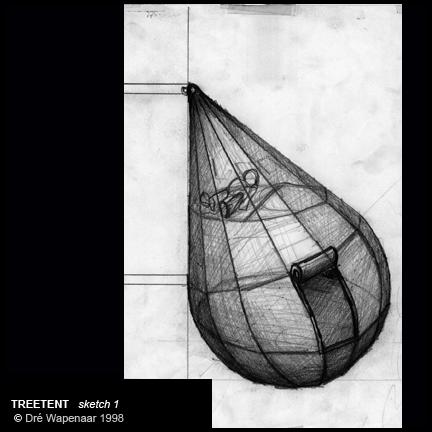
[I really appreciate when designers show their process work.]

The unique shape of the tents is eye-catching and appropriate. As Fleke Konljn wrote for an exhibition, "The Tree Tents, of which three have been made to date, were inspired by the Road Alert Group in England. These activists chained themselves to trees which were due to be cut down in the hope of saving them. Wapenaar set himself the notional commission of designing a tent which would make their vigil among the branches more agreeable. He designed the tent in the form of a water drop... What a fine picture it would make: tents hanging among the leaves and branches like green tears, a sign of mourning."
In the end, I love that the shape of the tent was wholly derived from the function that prompted Wapenaar to design a living space.
Of course, that is a highly romanticized view of the reality of both protest and the design of the tents themselves. According to Wapenaar, “the form of these tents naturally developed itself, when I hung a circular platform with a rope on the side of a tree. My inspiration for the shape was not the dewdrop. Form followed function.”
In the end, I love that the shape of the tent was wholly derived from the function that prompted Wapenaar to design a living space.
Originally found on ReNest and Inhabitat. Images and quotes from Dre Wapenaar.
Wednesday, February 2, 2011
design quote
"It’s not about paper, it’s not about forms. It’s about space and material.”
-Peter Zumthor, architect and 2009 Pritzker Prize winner
-Peter Zumthor, architect and 2009 Pritzker Prize winner
Tuesday, February 1, 2011
pretentious foodie post
I've been meaning to write this post since December, but every time I started it it just sounded like a dreaded foodie post. So now I'm just sucking it up and writing a foodie post.
But it really can't be too much of a foodie post because pretty much all I'm going to talk about is bacon. And I've loved bacon my entire life, even when I refused to eat most foods. Now, many kids don't eat their vegetables (and I didn't) but I also did not eat macaroni and cheese or most other forms of cheese, a childhood staple. I downed bacon, though. I didn't (and still don't really) eat eggs, so bacon and grits was my favorite breakfast. (Oh, hello. Forgot I'm from the South?)
So my love of bacon + increasing willingness to eat new foods= Husk, my new favorite restaurant. Anywhere. I'd recommend it to anyone visiting Charleston, SC, except maybe my vegetarian friends. There is too much bacon to leave still vegetarian.
Husk sources its ingredients locally and lists where each item is from on a large sign in the entrance, whether it's the bacon, benne seeds or clams. They say, "If it doesn’t come from the South, it’s not coming through the door." The focus is on Southern ingredients in Southern, particularly Low Country, recipes. All food is sourced fresh and the kitchen preserves, smokes and pickles the abundance. The menu changes daily. Sure, they list the source of most items on the menu, a common complaint of "foodie"-haters, but our waitress couldn't be described any way other than friendly and chill.
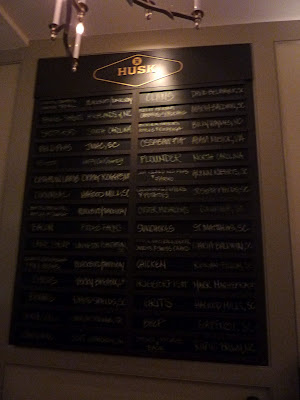 [Local food]
 [We ate every bit of the broth.]
 [Due of pork. Pork belly and tenderloin, with parsnips, apples and granola.]
 [Due of beef- filet mignon with bok choy and carrots.]
 [Due of beef, other side. Ragu and mashed potatoes.]
Husk Restaurant, Charleston, SC.
But it really can't be too much of a foodie post because pretty much all I'm going to talk about is bacon. And I've loved bacon my entire life, even when I refused to eat most foods. Now, many kids don't eat their vegetables (and I didn't) but I also did not eat macaroni and cheese or most other forms of cheese, a childhood staple. I downed bacon, though. I didn't (and still don't really) eat eggs, so bacon and grits was my favorite breakfast. (Oh, hello. Forgot I'm from the South?)
So my love of bacon + increasing willingness to eat new foods= Husk, my new favorite restaurant. Anywhere. I'd recommend it to anyone visiting Charleston, SC, except maybe my vegetarian friends. There is too much bacon to leave still vegetarian.
Husk sources its ingredients locally and lists where each item is from on a large sign in the entrance, whether it's the bacon, benne seeds or clams. They say, "If it doesn’t come from the South, it’s not coming through the door." The focus is on Southern ingredients in Southern, particularly Low Country, recipes. All food is sourced fresh and the kitchen preserves, smokes and pickles the abundance. The menu changes daily. Sure, they list the source of most items on the menu, a common complaint of "foodie"-haters, but our waitress couldn't be described any way other than friendly and chill.
 [Local food]
Our meal started with rolls with a bacon butter that I will never be able to recreate but somehow the smooth butter tasted like smoked bacon, perhaps due to bacon fat in the butter. To start we ordered a sampling of cured ham and housemade pickles, as well as fried chicken skins with a spicy honey dipping sauce, and wood fired clams with sausage, peppers and tomatoes and crispy bread.
 [We ate every bit of the broth.]
 [Due of pork. Pork belly and tenderloin, with parsnips, apples and granola.]
 [Due of beef- filet mignon with bok choy and carrots.]
 [Due of beef, other side. Ragu and mashed potatoes.]
Husk Restaurant, Charleston, SC.
Subscribe to:
Comments (Atom)


