Wednesday, October 7, 2015

honoring the past to inspire the future


I'll admit. I love old buildings. Whenever I see an older building that has been neglected, I dream of what could be. But even I didn't expect to gasp out loud when looking at images of this cultural center in a former bank in South Side Chicago. It's that good.

The Stony Island Arts Bank is the latest project of Rebuild Foundation, an organization dedicated to to rebuilding the cultural foundations of underinvested neighborhoods and inciting movements of community revitalization that are culture based, artist led, and neighborhood driven. With that goal in mind, the way the Arts Bank's design does not merely restore the bank to its former glory, but uses the decay to create a new design that honors the original design, the more recent past of neglect, and the current mission, all in order to inspire the future of those who enter.


[Images originally found on Slate.]

Wednesday, September 16, 2015

read more: homeless youth defining their own identity

["Fleur" photo by Natalie Brasington]

"How do you wish to be seen?

This is the question behind "The Portrait Project," an exhibition celebrating the strength and resilience of individuals and families experiencing homelessness..."At a time when NYC homelessness is at record highs, one of Art Start's missions is to start a dialogue about what it means to be seen," explained Johanna de los Santos, co-executive director for Art Start, in a statement. While the majority of visualizations depicting contemporary homelessness summon feelings of compassion, sympathy and frustration, Art Start hopes to shift the dialogue, celebrating the fortitude and enduring imagination of the pictured individuals, who refuse to let their circumstances define their identities."
- Priscilla Frank, The Huffington Post

Tuesday, July 21, 2015

personal style, a little bit of everything


"I have the honor of interviewing talented designers for each issue of Rue Magazine, and a question I frequently ask is “how do you define your personal style?” There is often a long pause, as this question can be difficult. Yet flipping through each designer’s website, their personal style becomes obvious, even if it is hard to label.

Glancing around my own apartment, I wonder if my own style is as visible. My closet is easy. My fashion sense is somewhere between Audrey Hepburn and Katharine Hepburn. My dream home? A combination of Marcel Beuer and Antoni Gaudí… with a dash of Louis XIV."

I had the honor about writing about my confusing, conflicting, and perhaps undefinable personal style for Rue Magazine. Read it on page 40 of our latest issue and I promise the rest of the issue is just as delightful. 

Friday, April 10, 2015

a uniform is never thoughtless

"With a fairly important meeting on the horizon, I started to try on different outfits, lacking any real direction or plan. "Is this too formal? Is that too out there? Is this dress too short?... As I arrived at work, my stress level only increased as I saw my male creative partner and other male co-workers having a "brodown" with the new boss as they entered the meeting room—a room I was suppose to already be inside. I just stood there—paralyzed by the fact that I was not only late, but unprepared. And my sweater was inside out." 

Matilda Kahl's piece for Harper's Bazaar was the first article on wearing a self-imposed daily outfit that hasn't left me wanting to tear our my hair. (See: Stuart Heritage in The Guardian's How to be as successful as Obama and Zuckerberg: wear the same clothes every day. It may work for the President but how would that work for Michelle Obama?) 

I like Kahl's piece because I agree. Uniforms can be powerful. I love Janelle Monae's commitment to her black and white style and have long expressed admiration for the architecture professors of the world who look chic in daily black. Her feeling of panic  at getting dressed is one I have felt many times and I, too, have a standard look that I put on no matter the situation when I'm unsure- dark jeans, a button down shirt, and some oversized necklace. 

Kahl and Heritage agree that thinking about exactly what to wear takes up amount of time and brain space, sometimes distracting from other things that need to get done. Heritage however frames it as time that the busy men he profiles just can't be bothered to take. That taking the time to think about clothes is trivial or a waste. What Kahl gets, perhaps better than most given her job as Creative Director, is that no matter what we wear we send a signal. Zuckerberg does it in his hoodie, and it's a signal that works for him both because of who he is and what his surroundings are. It would not work for President Obama for the same reasons. (And when Zuckerberg met Obama? He wore a tie.) Kahl saves herself time now by wearing a uniform, but it only works because she thought through a work outfit that would always be appropriate. 

Me? I'm not giving up a rainbow of colors (okay, yes, mostly blue and green and sometimes red.) But I get it. Now excuse me, I've got to throw on a button down and get to work. 

Saturday, January 17, 2015

read more: on branding

“It’s a mistake to think the consumer cares as much about your brand as you do. They may spend 2 seconds of their day thinking about you, so you have to nail it in the fewest words possible, and be relentlessly consistent.”
- Barney Waters from K-Swiss, in Hypebeast interview of three street wear brands

Tuesday, December 30, 2014

i actually use mailchimp

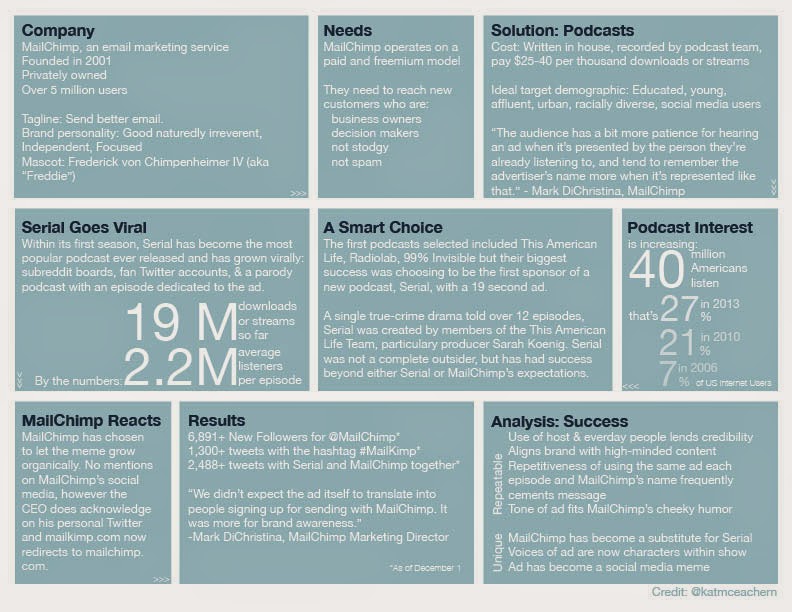
Sad it's all over? No, I'm not talking about the holidays. I'm talking about the end of Serial. While Jay may have finally stepped forward to give his account, our Thursdays are missing the most popular podcast of time, brought to you by MailChimp.

I loved Serial as a fan of podcasts, and while I initially cringed every time I heard "MailKimp," the marketing geek inside me was fascinated by their lucky break. They actually managed to become part of the story of Serial.

But just how did MailChimp's 19 second ad get to be "the official sponsor of engrossing teenage murder sagas everywhere?" (@JeffLoveless.) Here's a little case study I wrote up.


*I actually created the graphic in early December before the finale so the numbers are already out of date. 

Thursday, November 6, 2014

not lovin' it

[Not.]

Rumor has it McDonald's will be launching a new campaign "Lovin' Beats Hatin'." I get where they are coming from, using this as a way to build on the "I'm lovin' it" campaign (and they say that slogan will stay around.) I can hear that "da-da da da da" refrain in my head and have a habit of saying "I'm lovin' " despite it being quite a while since my last Big Mac, so it seems the campaign was successful. I'm not sure that "Lovin' Beats Hatin' " is the right way to go, however.

I'm not a McDonald's fan, so maybe I'm in the minority, but I think this butts up against something that should be avoided in advertising- saying what you don't want people to think.

McDonald's knows they face a myriad of criticisms- charges that they are causing a childhood obesity epidemic, Super Size Me, being the focus of the fast food workers unionization movement, pink slime, and the list goes on. So should McDonald's encourage loving over hating? Or does it just feel like Mickey D is asking people to not hate them?

Tuesday, November 4, 2014

Monday, October 27, 2014

making things


Grad school. Three semesters in with one to go. I had been warned there would be a lull, or rather, a huge dip in motivation in this third semester. It's true. I've found it incredibly hard to be motivated to get my work done and at times, hard to be creative at all.

Making things has been extremely limited during my program, but it's hit an all time high. I get caught in a cycle of having school work to do so I put off creative activities (or social activities or exercise activities,) but then I procrastinate on actually doing the school work so I have no time later to do the creative activities. After three months, I finally got my act together and spent a fantastic few hours making new earrings for Concept 47. And I semi-blogged here this weekend (really just a little read more repost.)

It felt great.

So the question is, how do I do this more?

Image from Spacebarn on Scoutmob. 

Sunday, October 26, 2014

read more: the better-writen bio that could be mine

"I struggle often to justify my love of aesthetics. I love to rearrange furniture and choose lipstick shades and curate art collections and have amassed more than enough statement jewelry over the years, and I sometimes treat these gifts as if they’re burdens. I sometimes wish I could trade these passions for something more “worthwhile” – whatever that means – and then I realize how ridiculous that sounds. Gifts are gifts. Passions are passions. We don’t choose them; they arrive, packaged in cardboard. They’re often bubble-wrapped, I think, and sometimes I use that same bubble wrap to suffocate them. Lately I’ve been working really hard not to do that, and instead, to pop the wrap a bit at a time with a new challenge (pop) or project (pop) or pursuit (pop pop pop)."
- Erin Loechner, Design for Mankind on writing her 'real bio' 

Monday, March 17, 2014

the narrow spaces of capitalism's private spaces

Molly Osberg’s recent essay, Inside the Barista Class, struck a cord as I left the service world not too long ago (though it feels forever ago.) Though written about New York, the piece is quite applicable to San Francisco as well, but it was a simple sentence that I almost missed toward the end that really captivated me. “While the framing of the third place may have been useful for Starbucks’ promotional materials, Oldenburg’s theory really didn’t account for the realities of capitalism: that private business creates narrow spaces.”

Narrow spaces. 

As a lover of design who is fascinated by ways to create community, Ray Oldenburg’s idea of ‘third places’ has stuck with my since freshman year of college. In a city like San Francisco, there are many places to socialize but few qualify as true third places according to Oldenburg’s definition because few are ‘levelers,’ open places without status barriers. Instead, the majority are narrow spaces. In a city with real estate as expensive as San Francisco, how can we move from narrow space to true third spaces?

Monday, March 3, 2014

giving inspiration a little room to grow

It can be damned near impossible to find the time to be innovative, even as a designer. Anything outside of a particular assignment falls to the wayside and not leaving enough process time for certain project means a result that falls flat. Given the difficulty for me to find time to think creatively or explore a new idea, it's easy to imagine the struggle that others whose 'full time job' isn't innovating have.

Google has long been credited for sparking innovation with their policy of giving employees a percentage of their workday to spend on any project they'd like. A recent Inc. article outlined why other businesses should do the same, "By letting your team do whatever they want, you’ll attract the best people with the best ideas. At the same time, the insights your employees gain through their creative projects will enhance their work on your organization’s core offerings."

Reading this story, I was reminded of a tweet I saw a while ago and favorited it to look into later:

Tuesday, February 25, 2014

functional is design. beauty may not be.

Over the weekend I spotted an article in The New York Times being grumpily passed around Twitter. Reading quotes like the following made me grumpy, too:

When Peek, a start-up for booking travel activities, designed its first iPhone app, its co-founder and chief executive, Ruzwana Bashir, said she prioritized design over other factors. The app shows large photos instead of a list of activities, for instance, even though it meant Peek could not fit as many activities on each screen.

Designing Peek to have less activities per screen because it looks better is not design. Designing Peek to have less activities per screen because showing large photos makes it easier for users to navigate the app is design.

Unfortunately, this article was another story making a false distinction between how something works and how something looks. It refers to the former as 'function' and the later as 'design,' but really the design is how the two interact.

This is not to say all the examples in the article failed to be design. After all, in other cases the aesthetic improvements also increased usability. Despite the constant confusing of aesthetics as design, the concluding sentence gives hope: "first and foremost I look for empathy, because design is not art, it’s actually solving real problems for people."

Design can be functional. Design can be aesthetics. But design can never ever be aesthetics over function.

Sunday, February 23, 2014

Three steps to GoldieBlox's Success

GoldieBlox, a construction toy aimed at young girls that teaches the basic principles of engineering, has been in the news lately due to their Super Bowl ad sponsored by Intuit’s Small Business Big Game contest. I had the privilege of working for GoldieBlox almost two years ago. (In fact, the first post I wrote about it is here.) I’ve been delighted to watch its success, including Fast Company’s recent nod as one of the 50 Most Innovative Companies of 2014. The award is well deserved, but founder Debbie Sterling’s innovative approach to creating GoldieBlox is a lot deeper than one amazing idea. Not surprising given Debbie’s degree from Stanford in Product Design, her process for creating GoldieBlox was intentionally designed. Debbie is the type of client every designer is lucky to work for because she understood the work that is required to make innovation happen.

Step One: Research
Before Debbie created the toy that now is GoldieBlox, she started by understanding her audience. Debbie read research and spoke with child development psychologists to understand the way that young girls want to play. She realized that many young girls enjoy story based play and start reading at an early age. It was from these initial conversations that she came up with the building set and story combination.

Step Two: Bring others into the process
Debbie reached out to broad swaths of people. She rejected the celebrated trope of a lone creator, understanding that innovation is made better by having ideas get beaten up and improved. I was always impressed by how willing she was to talk to anyone interested about her idea and through that she was able to build a strong team.

Step Three: Test and revise
Even after initial user research proved that young girls were responding positively to GoldieBlox, Debbie continued to ask the design team to identify ways to revise the toy to enhance the learning experience. She was not satisfied by merely proving her initial concept but pushed to make the best possible toy before launching the Kickstarter campaign, and has continued to improve the toys and expand the line. I look forward to seeing what comes next.

Saturday, February 22, 2014

read more: sustainable web design

"How can the web have a sustainability problem when 'paperless' and 'eco-friendly' frequently share the same sentence? After all, designers in many disciplines are trying to fix their own sustainability problems by moving them online – in other words, things are made 'green' when they go on the web...While some products become more sustainable by converting them to a swarm of bits, we must remember that those bits require something very physical to exist – a big, high-tech network, using lots of electricity and always-on computers to operate."

Tuesday, November 19, 2013

starting over

This week a professor assigned a writing exercise: one to two sentences that "distill your career and life experience and create a succinct statement about yourself as an innovator." It seemed like an overwhelming requires, but soon after I started brainstorming, my sentences became clear.

Striving to create change is only half the equation. If purposeful change is the desired outcome, it must be intentionally designed.

I am a designer. I am an activist. I strive to create stronger communities, safer communities, more beautiful communities. Solely ending existing injustices will not create this change, I must envision, articulate and build it. Something to remember during these late nights of work. We all must design it, together. 

Saturday, October 12, 2013

read more: the duty of design

"It is enough for good design to be things we cherish because they are beautiful, well made, or a pleasure to use, but it seems to me that our daily lives are dominated by barely competent and sometimes downright sinister works of industrial design, and I do not understand why designers don’t spend more time chasing down these opportunities.

The whole infrastructure of security and surveillance that dominates our experience of the city today (to take just one example) has gone untouched by the field of product design in any meaningful way. These are works of design that take justice and trust as their topic, and they make it pretty clear how those in power think of us as citizens."
Kieran Long, On the Civic Duty of Product Design for Dezeen 

Thursday, August 22, 2013

My office on Glitter Guide


Yesterday I had the honor of having my office featured on Glitter Guide alongside several of my Rue colleagues and other amazing business women. While still very much a work in progress I love my little office and was excited to share. Plus amazing photographer and friend Anna Marks shot my space and made it look amazing. 

We only got to share one image on Glitter Guide so my other favorites are below the jump. Then head over to Glitter Guide to read my tips for staying organized.

Wednesday, July 24, 2013

gravity and grace


A friend sent me a link to the art work of El Anatsui after she saw his work at the Brooklyn Museum. El Anatsui " converts found materials into a new type of media that lies between sculpture and painting, combining aesthetic traditions from his birth country, Ghana; his home in Nsukka, Nigeria; and the global history of abstraction." His show, Gravity and Grace, at the Brooklyn Museum has "over 30 works in metal and wood that transform appropriated objects into site-specific sculptures." 

Monday, July 22, 2013

new collection launched


Recently I shot my newest collection of jewelry with the help of three amazingly talented women- Kelli Ryder, my teammate at Rue and a talented stylist, Anna Marks, an wonderful photographer, and Sarah Long of Sarah's Ambitions, shown here as my stunning model.

I'm thankful that they got a great reception at the Rue office and our Editor-in-Chief chose to give a sneak peek of the still-in-development lookbook on Rue Daily. I've saved my favorite images for Rue so hurry over and check it out.

Then get your summer shopping done online on my online shop or BRIKA.